
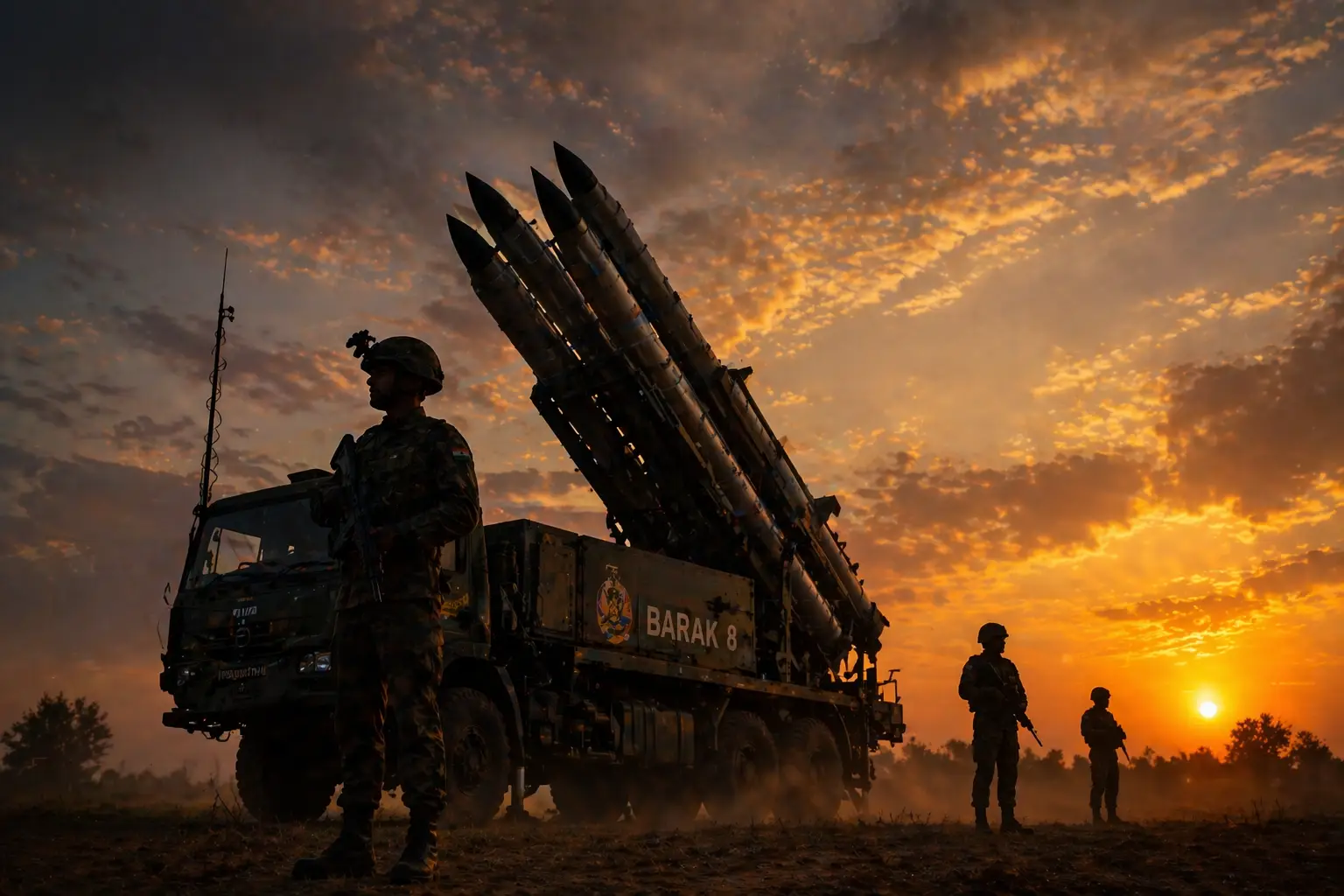
Discover how the IAF Haryana unit intercepted a Pakistani missile during Operation Sindoor using the Barak-8 system. Detailed features and mission insights inside.
The Secret Interception: How the IAF Haryana Unit Protected the National Capital
The Indian Air Force has recently brought to light a high-stakes aerial engagement where a specialized unit based in Haryana successfully intercepted and destroyed a Pakistani missile during the clandestine “Operation Sindoor” last year. This mission, which remained classified for months, underscores the immense pressure and constant state of alert that the Western Air Command maintains to protect the heart of the nation. According to military sources, the projectile was launched with the intent of striking a high-value target in Delhi, which would have led to an irreversible escalation in regional tensions. The Haryana unit, acting as a critical defensive gatekeeper, utilized advanced surveillance and tracking data to identify the threat within seconds of its launch. This successful neutralization not only prevented a potential disaster but also demonstrated India’s superior electronic warfare and radar capabilities. The operation highlights the strategic importance of the Haryana sector as a primary defensive shield for the National Capital Region (NCR), providing a secondary but vital layer of protection against long-range aerial threats originating from across the western border.
Barak-8: The Technological Marvel Behind India’s Aerial Shield
At the center of this successful defense was the Barak-8 Long-Range Surface-to-Air Missile (LRSAM) system, a product of deep strategic and technical collaboration between India and Israel. The Barak-8 is designed to counter a wide array of airborne threats, including supersonic fighters, cruise missiles, and ballistic projectiles, making it the perfect weapon for the scenario encountered during Operation Sindoor. What sets this system apart is its 360-degree coverage and the ability to engage multiple targets simultaneously in high-density combat environments. During the operation, the system’s advanced radar and command-and-control modules worked in tandem to provide a “lock-on” that was impossible for the incoming Pakistani missile to evade. The integration of this system into the IAF’s broader network-centric architecture ensures that every unit is fed real-time data, allowing for a synchronized response that minimizes human error. The Barak-8’s combat-proven reliability has once again established it as the backbone of India’s medium and long-range air defense strategy, proving its worth in a real-world, high-pressure combat situation.

Unmatched Maneuverability and Terminal Phase Precision
The technical prowess of the Barak-8 missile is largely attributed to its dual-pulse solid rocket motor, which allows the missile to retain high levels of energy even during the final, or “terminal,” phase of its flight. This is crucial because many modern missiles attempt to perform evasive maneuvers as they approach their target, but the Barak-8 can out-turn and out-accelerate almost any threat in the sky. Furthermore, the missile features an active radio frequency (RF) seeker head, which means that once it gets close to the target, it no longer relies on the ground radar to find its mark. It “sees” the target on its own, making it highly resistant to electronic jamming or decoys that an adversary might deploy. During Operation Sindoor, this autonomous guidance capability ensured that the Pakistani missile was neutralized with surgical precision, even if the enemy attempted to mask the projectile’s signature. This level of sophistication ensures that the IAF can maintain air superiority without needing to put pilots in harm’s way, relying instead on a wall of automated, lethal interceptors.
Strategic Deployment: Why the Haryana Unit Was the Final Line of Defense
The deployment of Barak-8 batteries in Haryana is a calculated strategic move aimed at creating a multi-tiered defense canopy over Delhi. While forward-deployed assets near the border are the first to detect an intrusion, the units stationed deeper inland like the one in Haryana provide the necessary depth to intercept missiles that might have bypassed initial defenses. During the events of Operation Sindoor, the seamless hand-off of tracking data from border sensors to the Haryana-based unit allowed for a continuous and unwavering focus on the incoming threat. This “defense-in-depth” strategy is essential for protecting political leadership and critical infrastructure from surprise strikes. The Haryana unit’s readiness level was reported to be at a peak, with personnel trained to transition from standby to launch in a matter of minutes. This operational efficiency is a testament to the rigorous training programs and simulated drills that the IAF conducts, ensuring that when a real threat emerges, the response is instinctive and flawless, leaving no room for a breach in the national security umbrella.

IAF Barak-8 Mobile Launcher Stationed for Defense
A critical component that empowered the Haryana unit during this operation was the Multi-Function Surveillance and Threat Alert Radar, commonly known as MF-STAR. This radar system is the “eyes” of the Barak-8 battery, capable of detecting and tracking hundreds of targets at ranges exceeding 100 kilometers. It doesn’t just see the targets; it classifies them, prioritizing the most dangerous threats for immediate engagement. In the case of the Pakistani missile aimed at Delhi, the MF-STAR radar was able to distinguish the high-speed projectile from other civilian or non-threatening aerial activity in the crowded northern Indian airspace. The radar provides mid-course guidance updates to the launched interceptors, ensuring they stay on the most efficient path to impact. The ability of the MF-STAR to operate in heavy electronic clutter and under intense jamming conditions makes it one of the most resilient radar systems in the world. Its success during Operation Sindoor has led to further investment in upgrading radar nodes across the country, creating a digital wall that is increasingly difficult for any adversary to penetrate.
Deterrence by Denial: The Geopolitical Impact of the Interception
The successful interception of a hostile missile has far-reaching consequences beyond the immediate tactical victory; it serves as a powerful tool of “deterrence by denial.” By demonstrating that their most advanced offensive weapons can be swatted out of the sky with ease, India sends a clear message to its neighbors that the probability of a successful strike is near zero. This significantly alters the risk-reward calculation for any military planner in Islamabad. Operation Sindoor proved that India’s investment in high-end air defense technology is paying off, creating a situation where the adversary’s primary weapon—missile intimidation—is neutralized. This stability-enhancing technology reduces the likelihood of a full-scale war, as the attacker knows their opening gambit will likely fail. The IAF’s ability to keep this operation secret for so long also indicates a high level of operational security and a preference for “silent deterrence,” where the military lets its capabilities speak for themselves through results rather than rhetoric, further solidifying India’s position as a dominant regional power.
Make in India: Building Self-Reliance in Missile Technology
One of the most encouraging aspects of the Barak-8’s success in the field is the high level of indigenous content involved in the system’s production. Under the ‘Make in India’ initiative, several Indian defense firms, led by Bharat Dynamics Limited (BDL) and Bharat Electronics Limited (BEL), have been instrumental in manufacturing the missiles and radar components locally. This domestic production capability ensures that the IAF is not dependent on foreign supply chains during a prolonged conflict, which is a critical vulnerability for many nations. The units stationed in Haryana are maintained and serviced by Indian engineers, ensuring high uptime and rapid turnaround for upgrades. The success of Operation Sindoor serves as a validation of the joint development model, where foreign expertise is combined with Indian manufacturing and operational requirements. This has paved the way for the development of even more advanced versions of the Barak system, including the Extended Range (ER) variant, which will push India’s defensive reach even further, encompassing a larger portion of the subcontinent under its protective wing.
The Future of India’s Air Defense Doctrine Post-Operation Sindoor
The lessons learned from the interception during Operation Sindoor are already being integrated into the IAF’s future air defense doctrine. There is now an even greater emphasis on “automation and AI integration” within the command-and-control structures to further reduce the time between detection and interception. As hypersonic missiles become a reality in the region, the IAF is looking toward sensors that can track faster, lower-profile targets with even greater accuracy. The Haryana unit’s performance has set a new benchmark for other missile batteries across the country, leading to a nationwide review of response protocols. Furthermore, the integration of the Barak-8 with other systems like the S-400 Triumf and the indigenous Akash missile system is creating a truly “layered” defense. This means that if a threat is missed by one system, another is ready to take it down at a different altitude or range. For the residents of the National Capital, this evolving technology represents a silent but powerful promise of safety, ensuring that the skies remain clear and the nation remains secure against any form of aerial aggression
Data Source: Verified via Google Trends and Military Intelligence Reports.
The operation demonstrates the IAF’s commitment to maintaining air superiority and safeguarding national security. Continuous training and simulation exercises have been integral in preparing personnel for such high-stakes scenarios, thereby enhancing operational efficiency. Furthermore, the integration of advanced radar systems and interception protocols has resulted in a more resilient defense posture. This successful engagement sets a precedent for future defense initiatives, emphasizing the necessity for ongoing investment in military technology. As the IAF continues to adapt to new challenges, collaboration with allied forces will further strengthen collective security measures in the region.
1 thought on “Operation Sindoor: IAF Intercepts Missile in Haryana”